🎮 Gamifying Marketing: Why Growth Should Work Like a Video Game
Learn how to gamify marketing using video game principles. Small tweaks, clear goals, and smart systems make growth fun — and scalable.





Learn how to gamify marketing using video game principles. Small tweaks, clear goals, and smart systems make growth fun — and scalable.

Email marketing for events is one of the most important tools you can have in your promotional toolbox.
Think about it. With social media advertising, you have to interrupt someone’s feed to get them to notice you. Email has the upper hand in this situation because people already subscribed to get your messages. Plus, an email stays in the consumer’s inbox until they delete it.
And if you need more reason to use email, you should know that email marketing still has crazy amazing conversion rates. In fact, SalesForce reports that email marketing has an ROI of about 4400%. That means for every $1 you spend, you get $44 back.
Lastly, you own your email list. You could lose your reach on social media in a split second if the platform wants to shut you down or changes their algorithm. Your email list, in contrast, is yours.
The question is… how do you leverage email marketing for events to get the most bang for your buck?
Lucky for you, I have a whole in-depth training on that very subject. You can watch the full training in this post, or you can fast forward to specific time stamps I provide in this article. Enjoy!
To start, we’ll look at three different types of emails you should definitely be sending your subscribers:
Each of these are super important, so make sure you’re using all of them!
Let’s look at the first one.
Transactional emails have the highest open rates—up to 60-80%! And yet they’re the most under-utilized type of email.
But what are transactional emails? They’re the emails that confirm someone’s pre-registration. Or they may provide a customer’s ticket receipt or order confirmation.
Support tickets, account resets, password resets, and customer services emails also fall into this category.
These emails are often automated, so I encourage you to regularly audit them and make sure your messaging is on brand.
Also be sure these emails ask your audience to take the next step of their buying journey. That can be asking them to follow you on social, share the event with their friends, or RSVP on the Facebook Event Page.
Relational emails are the ones you send to new subscribers to welcome them to your list.
They’re also the ones you send for your newsletter or blog articles, public relations, surveys and review requests, social updates, contest announcements, or referral requests.
The most important relational email is the one you send to your new subscribers. Take the time to initiate them with a welcome email. Lay out for them everything they can expect from you. That includes how frequently you’ll email them, what offers they’ll receive, and more.
If you have a particular persona or person behind your brand, this is the perfect time to put a face to the name!
Your promotional emails are the ones you send for price bumps, new products, event releases, sales announcements, and offer upgrades.
Promotional emails are by far the most popular type of emails that businesses send. And to be honest… they’re the ones in most need of a refresh.
Don’t get stuck in a cadence. Think of these promotional emails as your “popcorn.” No one wants stale popcorn. Keep the content fresh and relevant—and take advantage of holidays if you can!
This is a great opportunity to add some FOMO to your emails. For instance, if you have a VIP offer for your event, let your subscribers know how much they’ll miss out if they don’t upgrade their ticket.
Put a hard timeline on that upgrade to increase the sense of urgency to buy.
This is such an important topic to discuss because if someone isn’t getting your emails, they’re not going to see your promotions!
Keep a close eye on these three variables to make your email deliverability as high as possible.
Keep your email reputation high by being consistent in your emails sends. Make sure you don’t send spam, and always use a clean list.
By that, I mean make sure people opt-in to get your emails. You can get blacklisted otherwise.
Also make sure you send fun, relevant content so that you don’t get a bunch of unsubscribes.
Make sure you authorize your domain address that sends your email. And validate your IP addresses, too, while you’re at it.
These are more technical suggestions. But for now, just make sure you use a solid email company and fill out all your details.
Open rates are important when it comes to engagement, as are clicks and replies.
If someone hasn’t opened your email in over month, I recommend deleting them off your list. Keeping them on can lower your open rate and make it easier for inboxes to mark you as spam.
Increase your opens by making your subject lines as eye-catching as possible. Use subscribers’ names in your emails, which most email service providers can do.
Of course, don’t be boring! Be relevant, bold, fun, and entertaining where you can. Use specific numbers to grab your readers’ attention and keep it short. Don’t lose their attention!
You can use the preview copy to hook their interest. Symbols or emojis are a great way to catch the eye, so use those when you can.
To increase your click rate, try adding a play button on top of your images or animated GIFs. (Canva is great for this!) Or try creating a poll in your email. Interactive countdown timers and animated buttons are also great ways to get people to click in your email.
Go to 31:55 to learn how to revive a dying email list!
Some great options for email service providers are ConvertKit, MailChimp (which is free up to 1,000 subscribers), and HubSpot.
I’ve had clients A-B test against other platforms, and they really didn’t find a big difference. Just make sure that the company you go with has a good reputation.
Make sure the company is easy to use and helps you set up automation sequences. Also make sure the service provider is within your price range. Choose something that’s reasonable, but of course prioritize ease of use.
Don’t overlook SMS, or text-message marketing. Start collecting phone numbers now. (Just make sure you’re using the proper opt-in language!)
My clients see higher conversion rates with SMS than any other platform. Seriously!
With texting, you’ll want to customize the name and photo when you can.
Keep in mind that texting can be costly. Right now, I recommend only using it for FOMO offers with a set timeline. (For example, texting about a power-hour flash sale.)
Some good tools to use for texting are SimpleTexting, Twilio, and SuperPhone.
With these strategies in your pocket, you’re sure to nail your email marketing for events. Still have questions? Join my Six-Figure Freelancer Facebook Group and ask fellow entrepreneurs there!

Marketing events doesn’t have to be a scary process. But it will be if you don’t know what you’re doing!
The worst thing you can do when marketing events is wasting your budget and time because you weren’t utilizing best practices.
I’ve marketed events for plenty of clients, including Fortune 500 companies that gave me a multi-million-dollar budget for marketing! This experience taught me exactly what strategies, tools, and tactics work best when marketing for events.
Eager to learn? Watch my video to get the most out of this in-depth training on event marketing. Or you can fast-forward to the time stamps I provide throughout this article to learn more about a particular subject!
Before you start marketing events on social media, you need to have a strategy in place.
I’ve found that there are four types of social media content you need to have for an effective strategy. Those types of content are: Empower, Exhibit, Educate, and Entertain.
Let’s look at each one!
This content is supposed to embody authority and confidence. It should ignite someone else’s fire, motivate them, and encourage them to claim their own power and gift.
You can also make this content thought-provoking, philosophical, and inspirational.
Remember that people often have memories tied to events—whether those memories are tender or exciting. Use Empower content to play up this “memory-making” aspect in your marketing.
Will attendees make memories with family at your event? Will they commemorate a loved one? Will they accomplish something difficult?
This content should really showcase who you are and what your event is. That could include highlights of your event, who your speakers or performers are, who the leaders are, and so on.
Your brand story and personal story (depending on what kind of event you’re promoting) should really shine here. That’s what builds that human connection.
While you’re showcasing your event, be sure to incorporate a healthy amount of FOMO. 😉
Also, take this opportunity also to really focus on the attendees. Who are they? What’s their story? Why are they coming to your event?
Educational content is especially important in marketing events on social media. After all, it shows that you are the expert in your niche.
This type of content provides actionable advice. It’s not vague. It’s proven. Matter-of-fact. It’s the “Do this and get this result” kind of content.
This can include:
For instance, if you’re promoting a circus, you can offer a checklist for how to make the best memories with your kids at the event.
Of course, don’t forget your entertaining content! We’re all humans behind the screen, so make sure you make space to create content that’s just fun.
Be yourself, and be goofy. Do fun challenges, show bloopers or behind-the-scenes, host a challenge, or post memes.
TikTok is a great way to incorporate the fun content into your social media strategy.
So now that you know what to create, how do you actually go about coming up with specific ideas for content?
I have a few tips for you. First, keep a document open that you fill with your ideas as they come. Take screenshots of content you like and make sure you pay attention to what’s trending.
Also be sure to listen to what your community is telling you. You can either ask them directly, or you can look at your top-performing content over the past 90 days. This is a good indicator of what your audience enjoys.
Go to 22:43 to see an example of how to set up your content calendar with the 4 types of content.
Also, just a tip for you: The Empower and Entertain content will get you the most engagement, so I recommend plugging those into your content calendar the most!
And make sure you account for holidays when you’re creating your content calendar.
Content batching isn’t necessarily a revolutionary idea, of course. But you’d be surprised how many people don’t batch their social media content.
Some people choose to create their social content day by day. But this will consume a so much more of your time. I promise.
To batch, just block out a half-day every single week or a full day bi-weekly. Take that time to just work on creating social content.
First, write out all the copy you need for socials that week. Then start choosing images and graphics to go with it. Lastly, schedule out all your content for the week. And you’re done!
For scheduling (28:20), I recommend using SproutSocial. I like this tool because it lets you add a bunch of different platforms. The only one it’s missing is Pinterest, but you can use another tool for that.
SproutSocial has fantastic reporting and insights, making it easier to optimize your content.
Each week, look at your social media insights. Examine the three highest-performing posts and ask yourself: “What are the common threads with these three posts?”
Did you use a certain type of image? Did add a certain flair to your copy? Do the posts have hashtags in common? Are you tagging certain people?
Then examine your three lowest-performing posts. What are the common threads with those?
Make sure you also analyze the times of day you post.
One of the best ways to set your event up for success is by optimizing your social media profiles.
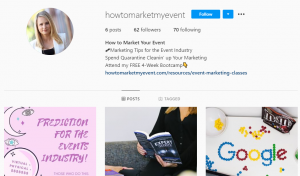
For Instagram, make sure you choose a username or profile name that has search benefits. For instance, my events marketing Instagram handle is @howtomarketmyevent and my name is “How to Market Your Event.”
Then, ensure that your bio clearly and concisely tells people what they get out of following you. End with a clear call to action (CTA) and provide a link that corresponds to that CTA. (Linktr.ee is great for putting multiple links in one.)
Here’s an example:
To make sure you’re getting the most reach and engagement possible, you must consider timing and engagement.
What time you post and on what day of the week does matter. That’s why you need to pay close attention to your social media insights! In general, the optimal times to post are first thing in the morning, lunchtime, and at the end of the day.
Regarding engagement, be sure to respond to every comment you get on your posts. This helps people feel more connected to you, plus social media platforms like it when you interact with your followers.
Remember that Facebook and Instagram consider direct messages as the highest form of engagement, so make sure you regularly tell people to DM you in your posts.
Go to 56:40 to learn how to increase your organic reach with Instagram stories! (Hint: you’ll want to start using in-app features…)
But social media alone won’t be enough when you’re marketing events. You also need reviews.
Why? Because reviews support your search engine optimization (SEO). So the more reviews you have, the more you’ll organically show up in search engine results.
Reviews also provide social proof (trust) to help drive sales to your event.
Think about it. When you are considering attending an event, what’s the first thing you do? If you’re like most consumers, you check out the reviews! According to Qualtrics, 82% of consumers read a product review before they purchase an online item.
Unfortunately, bad reviews can damage your standing with search engines and sites like Facebook. How do you mitigate that? Communication! If you have to cancel your event, make sure you communicate that to attendees clearly and give refunds.
With that in mind, realize that you’ll always get negative reviews when you’re marketing events. But you can use them as valuable feedback. As unpleasant as bad reviews are, they’re valuable insights into what you can improve.
Got to 1:06:20 to learn how to get more positive reviews on your event.
And there you have it! Take advantage of the valuable insights in the in-depth training as you use social media and reviews for marketing events!

If you give a quick google search, there are PLENTY of really fun and creative guerilla marketing tactics done by big companies with big budgets. These guerilla marketing ideas for events may not be the most creative but are meant to be real ideas you can use to get scrappy with your marketing with little to no budget needed.
If you do not have performers because you are a 5K or a lantern festival – don’t exclude yourself from this tip. Think about it – if you are a mud run, get yourself muddy and pass out flyers at local gyms. If you are a color run, get yourself dusted, put on a tutu, and pass out flyers or color packs at a park or area where families are hanging around. If you are more of a festival-type event like lanterns or beer fest, think of little, inexpensive novelty gifts you can pass out – thing you are probably going to pass out anywhere at the event, such as a koozie, sticker, magnet, etc.
FUN FACT: Once I did a guerilla marketing campaign at SXSW and we hired 40 brand ambassadors to wear “nude suits” and run around the city looking naked. It certainly generated plenty of buzz and PR with the media.
Bonus points if you can turn this into some sort of flash mob 😀

While walking around downtown Houston a few months ago, I saw that Cirque du Soile had stenciled the sidewalks with their show logo. Simple. Inexpensive. Order the stencil and get out there on every street corner. Just be sure to use a paint/chalk that easily washes away. Their stencils were subtle – a soft gray/white. Just enough to capture your attention – but not too much attention to upset anyone or cross the line of graffiti.
Get on Instagram and research each city market you are going to. Identify 10-20 “influencers” that you could offer free tickets to in exchange for a social post. I wouldn’t spend too much money on this – many influencers will, of course, want to be paid sometimes for this promotion, but as an event on a scrappy budget, I would spend too much of your marketing budget here unless it ties in as a tactic to a well-thought-out marketing plan that includes Whitelist Advertising.
If you are having a difficult time identifying who to work with on social media – think about who would want to attend your event. Is it families? Would it help to get in front of moms? Try teaming up with local PTAs and offering tickets at discounted prices or a kickback to support their school for every ticket purchased through them. If you are an obstacle run race, think of local gyms – what kind of group discount can you offer them? Reach out to those local gyms and see how you can work together on something that benefits everyone.
You may not consider this “guerilla marketing” but when it comes to getting scrappy and finding ways to get your event out on the internet at little to no cost – event directories are a great way. Event directories can offer search engine optimization value as well as discoverability by its website users. Check out this post I wrote with a full list of directories you can submit an event to, as well as what to google to find local event directories.
This sounds simple enough, right? I’ve seen this work VERY well for circuses who I would consider experts in this category of local guerilla marketing. The circuses I’ve worked with create beautiful flyers that actually look like tickets. They go into local businesses and ask if they can keep them at their counters or at cashier checkouts and in exchange, they will give them some comped tickets for opening night.
This tactic is similar to event directories or working with local influencers. Try doing a simple search on Facebook to find Facebook Groups for local communities. Type in the city name on Facebook and choose the Groups tab to find local groups. Or you can type in your target audience “i.e. Mom Groups” and search for groups related to parenting in certain cities. Join these groups and share your event. Try not to be spammy though. This tactic, in general, is spammy – but could be effective if done with some class. Offer them a promo code and talk about how you plan to give back to the community if you are teaming up with a local charity? You could even ask these groups if they know of a good local organization or PTA you could team up with. Ask them how you can bring value to their community during the short time you are in town. Maybe if your event involves hiring local vendors for food, they could have great suggestions for you. Let them almost take part in being an active participant in planning your event. After all – it is their community and they can tell you what they want, and if they feel a part of the event, they are more likely to share with friends and family.
On Twitter, you can search for people who are looking for something to do in their city. Maybe they tweet something such as, “I’m bored” or “What is there to do in Knoxville?” Simply spend some time each day tweeting back to these people, “Hey, if you’re bored, come hang out. We go on at 7 pm – here’s a promo code for $5 off.”
Create Spotify Music playlists that have a similar vibe to your event. Now, unless you have a large following, this Spotify playlist isn’t going to bring in all the customers for you BUT, it does give you fun content that you can share in those local Facebook Groups you joined or Tweets you are sending. This content can be a nice break between the promotional content and can be a great way to get people pumped up (if you curate the songs just right) and wanting to buy tickets to your event. A little reminder on their morning commute.
Think about it, we often tie certain songs to special memories in our lives. Make a playlist that leaves them wanting to create memories that will last a lifetime. You are selling an experience after all.
Postcards are fairly inexpensive – you can get 1000’s for less than $100. Now, mailing them can get a little more costly – but this is a unique tactic that I can work really well. Even if you are not ready to shell out the cost to mail them, you can have someone do the good ole fashion door to door drop off in mailboxes. On the front side of the postcard, put a FUN picture of your event. On the back right something such as …”Sorry, we missed you last time, but we will be back in a few weeks. See you soon?” Even if the last time you were in that city was years ago, use a photo that leaves them feeling like they really missed out last time. Put a call to action for them to buy tickets on your site now with a promo code (unique promo codes can help you gauge as to whether or not this tactic worked for you).
Websites such as Unsplash (my favorite) allow you to upload photos that people can use essentially as free stock photos in marketing when needed. Let me give you a great example, I needed a picture of a person working on a laptop. I searched for it, then found an image of a man working at his computer – and just barley you could see what was on his screen. A website called Bench Accounting. The beautiful photo was uploaded by Bench Accounting. Now that’s some clever guerilla marketing. Go ahead, check out the website and type in your type of event. I.E. “Circus” or “Festival” or “5K run” and see what comes up. Imagine someone needing a photo for marketing and using something that has your business name in it?

Free Google Ad Credits! Good new to many of us who feel as it most of our marketing ad spend has been wasted this year due to having to reschedule events. Google announced this week that they will be pledging $800 million in ads and loans to support the economy as it deals with the COVID-19 crisis.
Of the $800 million, $340 of that will be set aside in ad credits for small business. In order to be eligible for free google ad credits is to have a Google Ad Words account that has been active in the past year.
The credit notifications should appear in your account in the coming months. Vague timing, but this all that’s been announced so far. When the credits do appear, they can be used for Google Search, Display ads, and YouTube campaigns.
It’s unsure at this time how much credit will be given to small and medium sized businesses at this time. As of now, any credits issued to your account will be good through the end of 2020.
You can stay up to date on the free Google Ad Credits HERE.
Sundat Pichai, CEO of Google, has posted a full response on their blog where you can find more details about the other $460 million dollars will be distributed.

By taking the time to submit your events to these different event listing directories you have a better chance of people finding your event organically through Google (hello, free traffic) as well as overall discoverability through these websites.
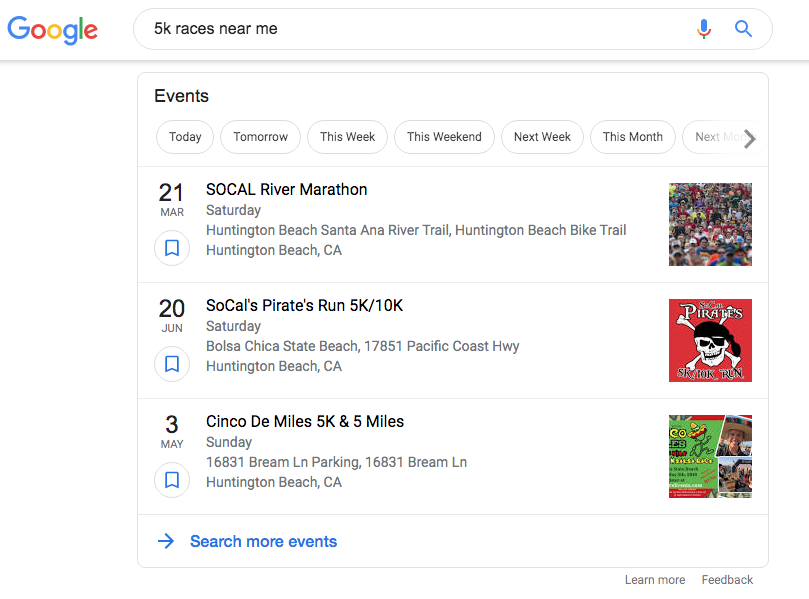
If you are a company that has more than one event (i.e. you travel to multiple cities throughout the year), I suggest you create an account on each of these platforms and be sure to submit all of your events to these sites as soon as you go on sale. Be sure to include KEYWORDS in your event title and description too for a better chance of being found. For example, if you are a mud run called SUPER DIRTY FUN (stay with me here), list your event name as ‘SUPER DIRTY FUN | 5K Mud Run | Toledo ‘ <--- as you can see, it has your event name, category keywords (5k run), and the city name.
Here’s the list I’ve put together, I’ll continue to keep this update. MOST of these sites are broken down by different local cities. Please leave a comment of other sites that you have found:
Now, once you’ve submitted the events you can to the above sites, DO NOT forget to focus on a local level. Here are some terms you can try Googling to find local websites and directories that you can submit your events to:
By taking the time to seek out the local news websites and local happening websites, I am usually able to find 3-7 additional websites to submit an event to per city, depending on the market.
Another idea is to seek out the websites related to your niche event industry. For example, if you are in the OCR arena, I’ve seen sites like Mud Run Guide or Let’s Do This work well to drive additional sales for clients. Please if you know other niche sites like this, leave a comment below!